Honda Hornet 2.0 Price in Bangladesh: Full Review & Specifications
The Honda Hornet 2.0 Price in Bangladesh is BDT 289,000, according to Bangladesh Honda Private Limited (BHL). Positioned as a higher-capacity naked street motorcycle in Honda Bangladesh’s lineup, the Hornet 2.0 combines a 184.4cc PGM-FI engine, 16.6 PS maximum power, 15.5 Nm maximum torque, a 5-speed gearbox, assist and slipper clutch, USD front suspension, and front ABS. It is designed for riders who want more performance and a sportier riding character than a conventional commuter without moving into a fully faired motorcycle.
The Bangladesh-market Hornet 2.0 was officially launched by Bangladesh Honda in September 2024. Honda describes the motorcycle as part of the long-running Hornet nameplate, whose legacy dates back to 1996. The Bangladesh model brings a muscular streetfighter design together with modern features such as a fully digital meter, LED lighting, side-stand engine cut-off, assist and slipper clutch, and a golden upside-down front fork.
For Bangladeshi riders, the Hornet 2.0 is particularly interesting because its 184.4cc engine and 142 kg kerb weight put it in a practical middle ground: it has enough engine capacity for regular city riding and highway travel while remaining considerably more compact and manageable than larger motorcycles.
Honda Hornet 2.0 Overview
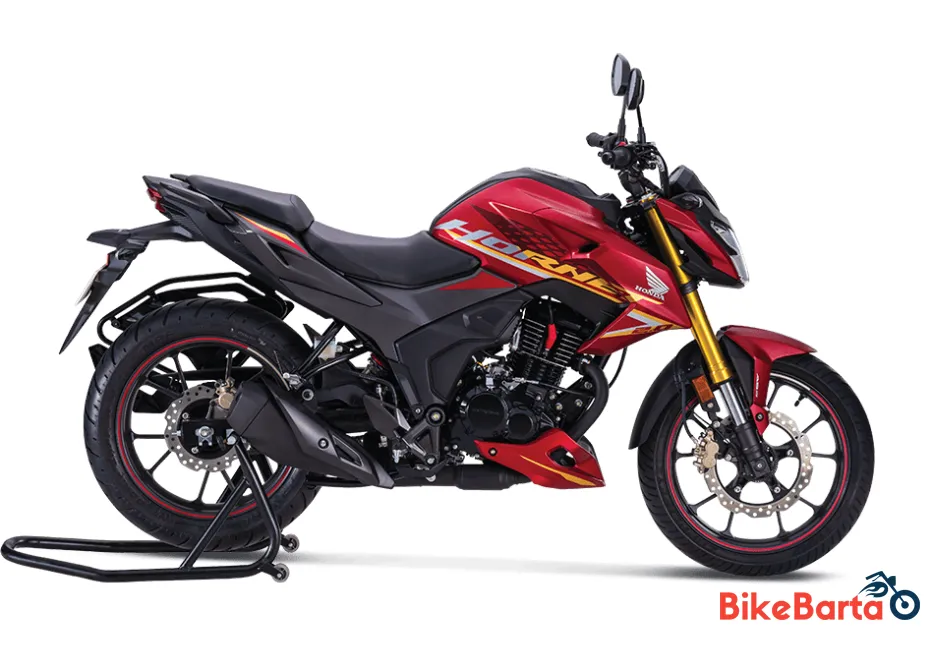
The Honda Hornet 2.0 is a naked street motorcycle with a clear emphasis on sporty styling and everyday usability. Rather than being built purely as a commuter, it uses a muscular fuel tank, aggressive bodywork, split seat, under-cowl and wide tyres to give it a more performance-oriented character. Honda also uses a golden upside-down front fork, which is one of the motorcycle’s most visually distinctive mechanical components.
At the centre of the motorcycle is a 184.4cc, 4-stroke PGM-FI SI engine producing 16.6 PS at 8,500 rpm and 15.5 Nm at 6,000 rpm. Power is delivered through a 5-speed manual transmission, while an assist and slipper clutch is used to make gear changes easier and help manage rear-wheel lock-up during aggressive downshifts.
Honda’s Bangladesh lineup also includes several motorcycles that may interest someone considering the Hornet 2.0. The Honda CB Hornet 160R is an earlier Hornet-branded motorcycle that was officially introduced in Bangladesh before the Hornet 2.0. The Honda SP 160 is another Honda street-oriented motorcycle using a PGM-FI engine, while the Honda NX200 offers a different, more adventure-oriented approach. The Honda XBlade is another sporty commuter-style Honda motorcycle in the Bangladesh lineup, while the Honda CBR 150R takes a more fully faired sports-bike approach. These are Honda’s other relevant models to consider, rather than being claimed as direct Hornet 2.0 generations or successors.
Honda Hornet 2.0 Price in Bangladesh
The current listed Honda Hornet 2.0 Price in Bangladesh is BDT 289,000. This is the price published by Bangladesh Honda Private Limited, although Honda notes that prices can change without prior notice.
Honda has also previously offered promotional pricing on the Hornet 2.0. For example, a January 2026 Honda cashback campaign listed a BDT 15,000 cashback on the blue version and BDT 10,000 cashback on the red, black and grey versions, but those were promotional offer prices rather than the standard listed motorcycle price. Therefore, the regular database price should remain BDT 289,000 unless Honda officially announces a new price or offer.
At this price, the Hornet 2.0 sits in a section of the Bangladesh motorcycle market where riders can choose between smaller-capacity commuter-oriented motorcycles and performance-focused 150–160cc naked bikes. Its larger 184.4cc engine, USD fork and assist/slipper clutch are important parts of the value proposition.
Engine and Performance
The Hornet 2.0 uses a 184.4cc, 4-stroke, PGM-FI, SI engine. Its official Bangladesh specification gives a maximum net output of 16.6 PS at 8,500 rpm and maximum net torque of 15.5 Nm at 6,000 rpm. The engine has a 61 mm bore, 63.09 mm stroke, and a 9.5:1 compression ratio.
The engine’s fuel-injection system is one of the more important characteristics for everyday Bangladesh riding. PGM-FI allows Honda to control fuel delivery electronically rather than relying on a traditional carburettor. This is useful for consistent engine operation across different riding conditions and contributes to the motorcycle’s balance between performance and fuel efficiency.
The 15.5 Nm of torque at 6,000 rpm is particularly relevant in city traffic. Riders regularly need to accelerate from low and medium speeds, merge into traffic, or move past slower vehicles. The Hornet 2.0’s engine has enough displacement to make these situations less dependent on constantly working the gearbox compared with a smaller-capacity commuter motorcycle.
Honda does not officially publish a maximum-speed figure on the Bangladesh specification page, so a specific top-speed number should not be treated as an official Hornet 2.0 specification. Likewise, acceleration figures such as 0–60 km/h are not officially published by BHL and should not be presented as measured factory data.
Fuel Injection and Everyday Engine Response
The PGM-FI fuel-injection system is an important part of the Hornet 2.0’s character. For a motorcycle used in Dhaka or other busy Bangladeshi cities, predictable throttle response matters because riding frequently involves starting, slowing, accelerating again and changing speed in short intervals.
The 184.4cc engine also gives the motorcycle more headroom than a typical entry-level commuter. When traffic opens up, the rider has more usable performance available for acceleration and overtaking.
At the same time, the Hornet 2.0 remains a single-cylinder motorcycle, so it is not intended to deliver the character or outright performance of a much larger multi-cylinder motorcycle. Its strength is the balance between everyday usability and a sportier riding experience.
Transmission and 5-Speed Gearbox
The Hornet 2.0 uses a 5-speed manual transmission with the official gear pattern 1-N-2-3-4-5.
The five-speed arrangement is appropriate for the motorcycle’s intended street use. Lower gears are useful when moving through slow traffic or accelerating from a stop, while the upper gears allow the engine to settle into a more relaxed operating range as speed increases.
The gear-position information is also displayed on the motorcycle’s fully digital instrument console. This can be particularly useful for riders who are becoming accustomed to a manual motorcycle with a five-speed transmission.
Assist and Slipper Clutch
One of the Hornet 2.0’s more notable mechanical features is its assist and slipper clutch. Honda says the system helps ease upshifts and manages rear-wheel lock-up during hard downshifts while decelerating.
For everyday riding, the assist function can make repeated clutch operation feel easier, which is useful in stop-and-go traffic. The slipper function becomes more relevant during aggressive downshifts, where excessive engine braking can otherwise contribute to rear-wheel instability.
This does not turn the Hornet 2.0 into a track-focused motorcycle, but it is a useful feature for a rider who wants a more refined manual transmission experience.
Mileage and Fuel Economy
Honda Bangladesh’s current Hornet 2.0 specification page does not publish a specific official mileage figure. Therefore, there is no responsible way to label a particular km/L figure as Honda’s official Bangladesh mileage.
Actual mileage will depend on traffic, throttle use, riding speed, road condition, rider weight, tyre pressure, maintenance and how frequently the motorcycle is operated in stop-and-go traffic. In Bangladesh, a Hornet 2.0 used mainly in congested Dhaka traffic will naturally consume fuel differently from one used predominantly on open highways.
For someone considering the motorcycle, fuel economy should therefore be treated as a real-world ownership factor rather than relying on a single claimed figure. The PGM-FI system is designed to manage fuel delivery efficiently, but riding style remains a major factor in actual consumption.
Design and Styling
The Hornet 2.0 follows a muscular naked streetfighter design. Its fuel tank is visually prominent, while the side shrouds, sharp body panels and under-cowl give the motorcycle a more aggressive appearance.
Honda describes the fuel tank design as energetic and muscular, with sporty side shrouds and refined graphics. The ignition key is positioned on the tank area, contributing to the motorcycle’s larger-capacity street-bike appearance.
The motorcycle also features a split seat, short sporty muffler and X-shaped LED tail lamp. These elements give the rear section a distinct appearance while keeping the motorcycle within the naked-bike format.
Honda Hornet 2.0 Colours in Bangladesh
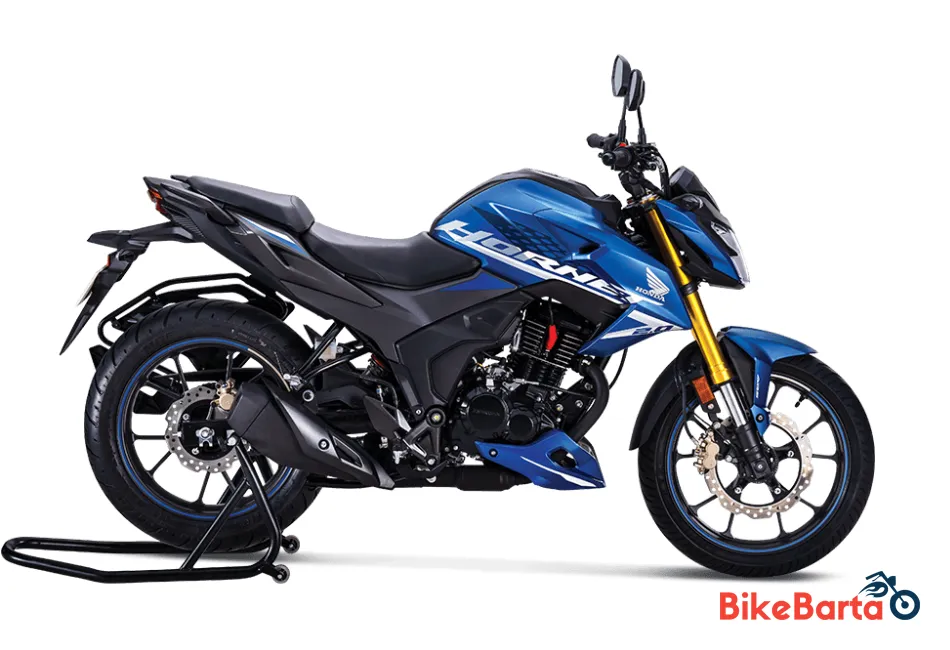
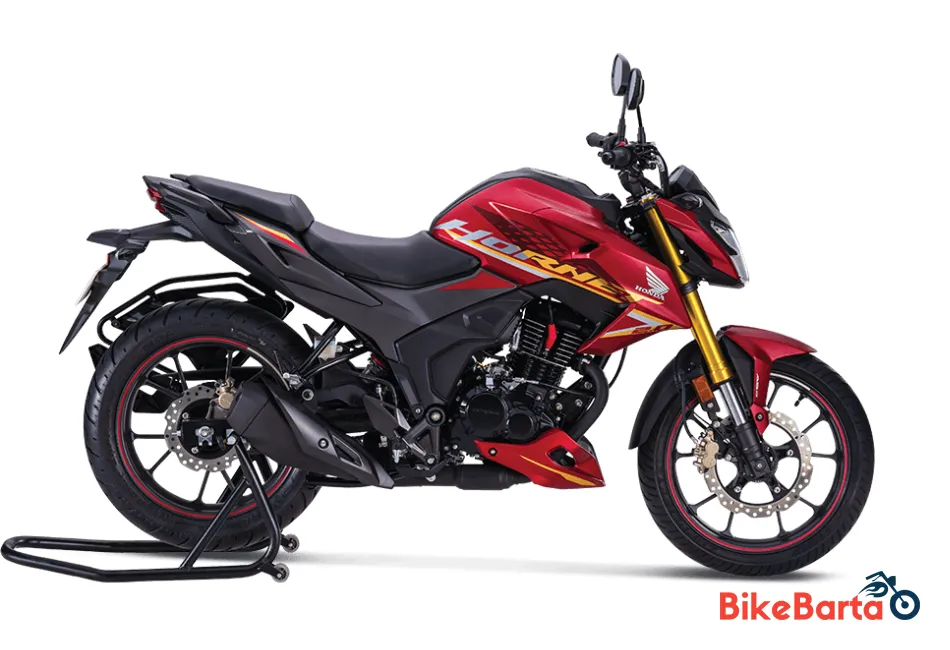
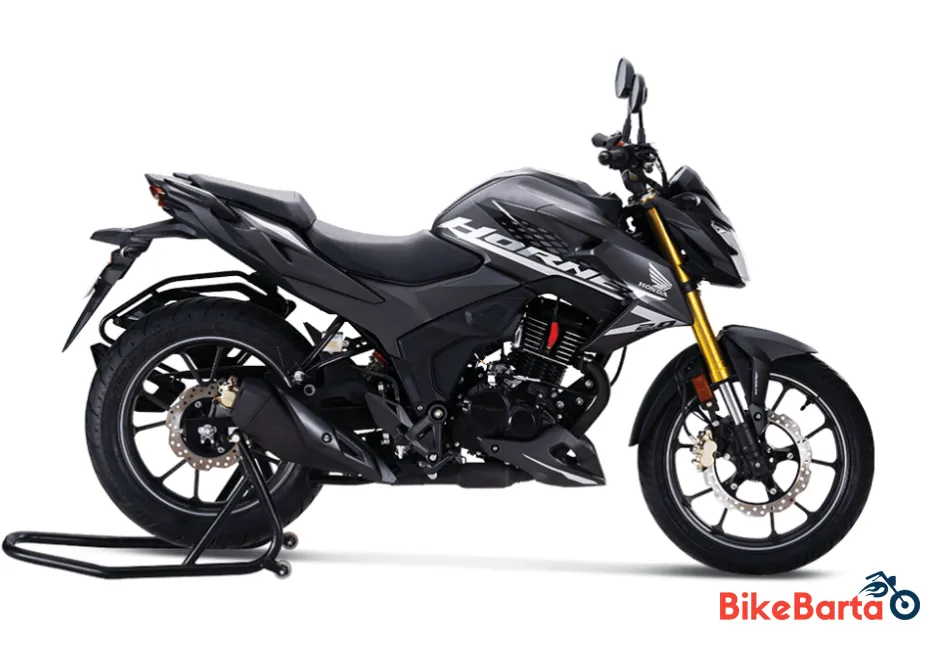
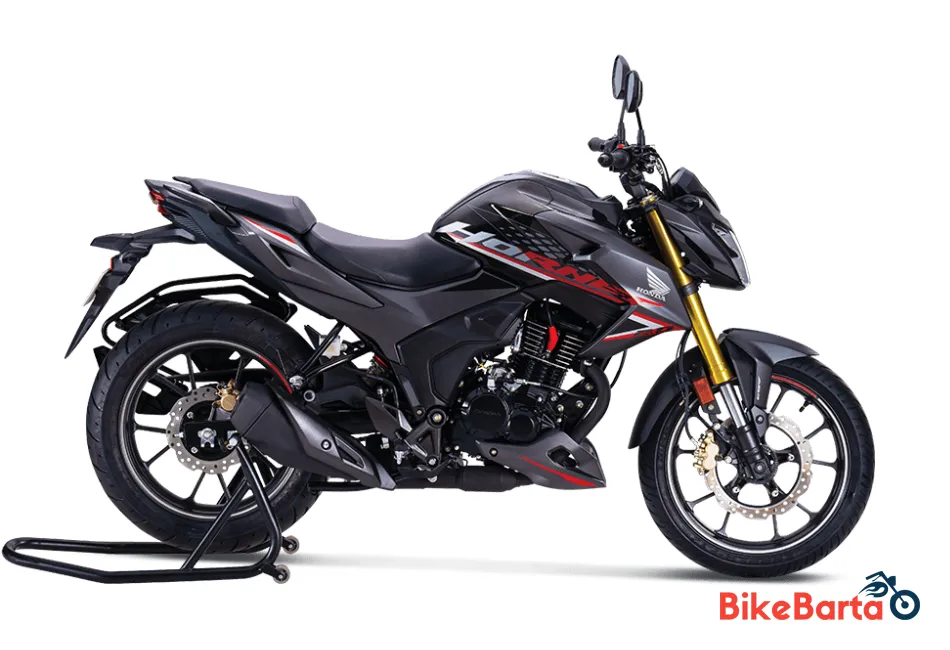
Bangladesh Honda lists four colours for the Hornet 2.0: Matte Sangria Red Metallic, Matte Marvel Blue Metallic, Matte Axis Grey Metallic and Pearl Igneous Black.
These colour choices complement the motorcycle’s muscular styling, while the tank and side-shroud design provide most of its visual identity. Availability of a particular colour can depend on dealer stock, so riders should confirm the available colour before making a purchase.
Dimensions, Riding Position and Practicality
The Honda Hornet 2.0 measures 2,034 mm in length, 783 mm in width and 1,064 mm in height. Its wheelbase is 1,355 mm, ground clearance is 167 mm, kerb weight is 142 kg, and fuel tank capacity is 12 litres.
The 167 mm ground clearance is useful for Bangladesh because everyday riding frequently involves speed breakers, road edges and uneven sections. It does not eliminate the need to slow down on poor roads, but the clearance gives the motorcycle reasonable practicality for mixed urban conditions.
The 142 kg kerb weight also keeps the motorcycle within a manageable range for a 184cc street motorcycle. This matters when moving the motorcycle manually, parking in tight spaces or negotiating congested streets.
Honda Bangladesh does not currently publish an official seat-height figure on the Hornet 2.0 specification information, so a specific seat-height number should not be treated as confirmed Bangladesh-market data.
Chassis and Suspension
The Hornet 2.0 uses a Diamond-type frame. At the front, it is equipped with an upside-down telescopic suspension, while the rear uses a monoshock.
The USD front fork is one of the motorcycle’s defining hardware features. Honda describes the golden upside-down suspension as being designed to absorb road shocks and improve handling.
For Bangladeshi roads, suspension performance is important because the motorcycle may encounter patched asphalt, uneven surfaces, speed breakers and rough road sections during otherwise normal commuting. The combination of USD front suspension and rear monoshock gives the Hornet 2.0 a setup more closely associated with sporty street motorcycles than basic commuter bikes.
The monoshock layout also contributes to the motorcycle’s overall handling balance. Honda specifically notes that the rear monoshock helps maintain the centre of gravity and supports stability and handling.
Brakes and Tyres
The Hornet 2.0 uses a 276 mm front disc brake with ABS and a 220 mm rear disc brake. Both ends use disc brakes, while the front braking system incorporates ABS.
The front tyre is 110/70-17 M/C 54S, while the rear tyre is 140/70-17 M/C 66S. Both are tubeless tyres.
The relatively wide rear tyre contributes to the motorcycle’s planted appearance and road-contact characteristics. Honda also highlights the wide tyre setup as supporting grip and handling confidence.
For city riding, the front ABS is particularly valuable when unexpected braking is required. In Bangladesh, where traffic can change quickly and vehicles can suddenly enter the rider’s path, having ABS on the front wheel provides an additional safety margin during hard braking.
ABS and Braking Performance
The Hornet 2.0 uses a BOSCH single-channel ABS system, with ABS operating on the front wheel. Honda’s launch information specifically identifies the system as a single-channel ABS setup combined with petal disc brakes at the front and rear.
This is important to understand before purchase. The motorcycle does have ABS, but it is not dual-channel ABS. Riders should therefore not assume that the rear wheel has ABS simply because the motorcycle carries an ABS-equipped front brake.
The 276 mm front disc provides substantial braking hardware for a motorcycle in this class, while the 220 mm rear disc provides additional braking control.
Features and Electronics
The Hornet 2.0 comes with a fully digital liquid-crystal meter. The console provides key riding information and includes a gear-position indicator.
Lighting is another major part of the motorcycle’s equipment. Honda provides an LED headlight, LED indicators and an X-shaped LED tail lamp. The lighting design also contributes significantly to the motorcycle’s modern streetfighter appearance.
The motorcycle also has an engine stop switch and hazard switch. The engine stop switch can be useful during short stops, while hazard lights can help make the motorcycle more visible during emergency stops or low-visibility situations.
A side-stand engine cut-off system is also fitted. Honda explains that when the side stand is engaged, the engine will not start and the side-stand indicator remains illuminated on the meter.
The available verified information does not establish features such as Bluetooth connectivity, smartphone integration, riding modes, traction control, cruise control or quick shifter. These should therefore not be considered part of the Hornet 2.0’s confirmed Bangladesh specification.
City Riding in Bangladesh
The Hornet 2.0 can make sense as an everyday city motorcycle for someone who wants more performance than a conventional commuter. Its 184.4cc engine, fuel injection, five-speed gearbox and relatively manageable 142 kg kerb weight suit mixed urban use.
In Dhaka traffic, the assist and slipper clutch is a useful addition because frequent stop-and-go riding means frequent clutch operation. The motorcycle’s upright naked-bike format also provides a practical riding position for dealing with traffic.
The main consideration is that a 184.4cc motorcycle with sporty hardware is not necessarily the most economical choice for someone whose only priority is minimum running cost. Riders who regularly travel very short distances through heavy congestion may prefer a smaller commuter motorcycle.
For someone who wants one motorcycle to handle commuting while also providing stronger acceleration and a more engaging riding experience when traffic opens up, the Hornet 2.0 is more compelling.
Riding Through Traffic and Narrow Roads
The motorcycle’s dimensions are fairly substantial for a commuter-oriented rider, but its 783 mm width and naked configuration remain practical for urban roads.
The wide tyres can provide a planted feel, although riders should remember that tyre width does not automatically make a motorcycle easier to manoeuvre through extremely narrow gaps. In congested roads, smooth throttle control and anticipation remain more important than outright engine power.
The side-stand engine cut-off is another practical safety feature for daily use, particularly for riders who frequently park and restart the motorcycle throughout the day.
Highway and Longer-Distance Riding
The Hornet 2.0’s 184.4cc engine makes it more suitable for highway travel than smaller commuter motorcycles. Its 5-speed gearbox allows the rider to use different ratios according to traffic and road speed, while the 1,355 mm wheelbase provides a useful foundation for straight-line stability.
The motorcycle’s riding position, wide tyres and suspension hardware also suit riders who occasionally leave the city for longer trips.
However, because Honda Bangladesh does not officially publish a top-speed figure, it is better to evaluate highway suitability based on the motorcycle’s confirmed engine output, gearing, chassis and braking hardware rather than promising a particular maximum speed.
For overtaking, the available 15.5 Nm of torque at 6,000 rpm gives the motorcycle useful mid-range performance, but riders should still select the appropriate gear and leave adequate space before passing another vehicle.
Cornering and Handling
The Hornet 2.0’s chassis and suspension package clearly support its sporty street-bike identity. The USD front fork, rear monoshock, 17-inch wheels and wide tyres provide the basic hardware expected from a motorcycle intended to offer more engaging handling.
The riding experience through corners will naturally depend on road surface, tyre condition, rider technique and speed. On clean paved roads, the motorcycle’s hardware should provide a more performance-oriented feel than a basic commuter.
On broken Bangladeshi roads, however, riders should not confuse sporty suspension hardware with permission to carry excessive speed. Potholes, loose gravel, standing water and damaged asphalt can compromise any motorcycle’s grip.
Rider and Pillion Comfort
The Hornet 2.0 uses a split seat, which contributes to its sporty styling. Honda specifically describes the split-seat design as part of the motorcycle’s streetfighter character.
The motorcycle can accommodate a pillion, but the split-seat layout and sporty design mean that comfort expectations should be realistic. For frequent two-up commuting, riders should consider the actual seat shape and pillion position during a showroom inspection or test ride.
For solo riders, the motorcycle’s overall layout is more naturally aligned with sporty everyday riding than with purely utility-focused commuting.
Maintenance and Ownership
The Hornet 2.0 uses a PGM-FI fuel-injected engine, so regular maintenance should focus on following Honda’s recommended service schedule, using appropriate engine oil, maintaining the chain and checking consumable components at the recommended intervals.
Owners should pay particular attention to engine oil, chain condition and lubrication, tyre pressure, brake-pad condition, brake-fluid condition, air filtration and battery/electrical health. These are normal maintenance considerations for a petrol motorcycle and become particularly important when the motorcycle is used daily.
Bangladesh road conditions also make regular tyre inspection important. A puncture-resistant riding habit cannot prevent every puncture, so checking tyre condition and maintaining appropriate pressure should be part of normal ownership.
Honda’s official Bangladesh product information should be treated as the reference point for servicing, genuine parts and maintenance requirements rather than relying on generic service intervals from another market.
Advantages of the Honda Hornet 2.0
The Hornet 2.0’s strongest advantage is the combination of its 184.4cc engine and sporty chassis. The 16.6 PS and 15.5 Nm outputs give it a meaningful performance focus, while the 142 kg kerb weight keeps the motorcycle from becoming excessively heavy for its class.
The assist and slipper clutch is another significant advantage for riders who value smoother gear changes and additional control during aggressive downshifts.
The USD front suspension, front ABS, dual disc brakes, wide tubeless tyres and LED lighting also give the motorcycle a well-equipped specification.
Its 167 mm ground clearance and 12-litre fuel tank further support its use as an everyday motorcycle rather than a machine intended only for occasional recreational riding.
Disadvantages and Things to Consider
The Hornet 2.0 is not designed to be the cheapest possible motorcycle to operate. A rider who prioritizes maximum fuel economy and simple commuting may find a smaller-capacity commuter more suitable.
The motorcycle also uses single-channel ABS rather than dual-channel ABS, which is an important consideration for riders specifically looking for ABS on both wheels.
Another consideration is information availability. Honda Bangladesh does not currently publish an official top-speed figure or an official mileage figure on the relevant product specification information. Therefore, riders should avoid relying on unofficial numbers when comparing motorcycles.
The seat height is also not officially specified in the current Bangladesh product information, so shorter riders should physically sit on the motorcycle before making a decision rather than relying on an unverified figure.
Honda Hornet 2.0 vs Everyday Bangladesh Riding
The Hornet 2.0 makes the most sense for someone who wants a motorcycle that can handle daily commuting but does not want the riding experience to end there.
For Dhaka commuting, the engine has enough capacity for moving confidently through traffic, while the five-speed gearbox and assist/slipper clutch add refinement. For weekend highway riding, the larger engine and street-focused chassis provide more scope than a basic commuter motorcycle.
Its 167 mm ground clearance is also useful for Bangladesh’s mixed road conditions, although riders still need to approach speed breakers and damaged roads carefully.
The 12-litre tank gives the motorcycle a reasonable fuel-carrying capacity, but actual range depends on real-world mileage and riding conditions.
Alternatives / Similar Motorcycles in Bangladesh
The Bajaj Pulsar N160 Dual Channel ABS & USD is one of the closest alternatives for someone who wants a modern naked motorcycle with strong safety equipment. BikeBD lists it at BDT 281,000, with a 160cc engine, 15.78 BHP, 14.65 Nm, and dual-channel ABS. Compared with the Hornet 2.0, the Pulsar N160 has a smaller engine but offers dual-channel ABS, making it particularly relevant for riders who prioritize braking safety.
The TVS Apache RTR 160 4V FI is another strong alternative near the Hornet 2.0’s price range. BikeBD lists the FI version at BDT 274,900, with a 160cc engine producing 17.30 BHP and 14.73 Nm. It also has single-channel ABS and is positioned toward riders who want a sporty street-bike character with strong performance from a smaller engine.
The Yamaha FZS V3 ABS BS6 offers a different interpretation of the same general street-bike purpose. BikeBD lists the Bangladesh-market motorcycle at BDT 268,000, with a 149cc engine, 12.8 BHP, 12.8 Nm, single-channel ABS and claimed mileage figures of around 45 km/L in city use and 50 km/L on the highway. It is therefore more focused on comfortable everyday riding and fuel economy than the more performance-oriented Hornet 2.0.
The Suzuki Gixxer is a lower-priced alternative, with BikeBD listing it at BDT 205,950. Its 154.9cc engine produces 14.6 BHP and 14 Nm, while BikeBD reports approximately 40 km/L in city riding and 45 km/L on the highway. Compared with the Hornet 2.0, the Gixxer offers a smaller engine and simpler specification, but its lower price makes it relevant for riders who want a sporty street motorcycle without spending close to BDT 289,000.
The Bajaj Pulsar NS160 Twin Disc ABS is another alternative for riders interested in a sporty naked motorcycle. BikeBD lists the model at BDT 210,000, with a 160cc engine, 15.3 BHP, 14.6 Nm, single-channel ABS and dual-disc braking. It is significantly less expensive than the Hornet 2.0, so its appeal comes from offering a sporty riding package at a lower entry price rather than matching Honda’s exact specification.
These alternatives demonstrate that the Hornet 2.0 is competing in a broad part of the Bangladesh motorcycle market. Some alternatives cost considerably less, while others approach its price. The Honda stands out through its 184.4cc displacement, 16.6 PS output, assist and slipper clutch, USD front fork and Honda Bangladesh’s local product support.
Who Should Consider the Honda Hornet 2.0?
The Hornet 2.0 is worth considering if you want a petrol-powered naked motorcycle with a stronger engine and sportier hardware while still keeping it practical for everyday road use.
It is particularly suited to riders who regularly commute but also want to ride outside the city, use highways, overtake slower traffic when conditions permit, and enjoy a more engaging motorcycle at the weekend.
It is less compelling for someone whose only priority is the lowest possible purchase price or maximum fuel economy. In that situation, several 150–160cc motorcycles can provide a lower-cost ownership proposition.
Is the Honda Hornet 2.0 Good for Dhaka?
The Hornet 2.0 can be a practical choice for Dhaka if the rider values performance alongside everyday usability. Its 184.4cc PGM-FI engine, 5-speed transmission, assist/slipper clutch and manageable 142 kg kerb weight make it suitable for mixed city riding.
The motorcycle’s 167 mm ground clearance is also useful when dealing with speed breakers and uneven road surfaces. Its front ABS provides additional braking assistance when traffic suddenly becomes unpredictable.
However, the motorcycle’s relatively sporty character means it should not be selected solely because of its aggressive appearance. A daily commuter should consider riding position, traffic conditions, fuel consumption, maintenance and pillion requirements before purchasing.
Is the Honda Hornet 2.0 Suitable for Highway Riding?
Yes, its 184.4cc engine, 16.6 PS power and 15.5 Nm torque give it a suitable mechanical foundation for highway riding. The five-speed gearbox and 17-inch wheel setup also fit its street-bike role.
However, Honda Bangladesh does not officially state a top-speed figure, so riders should not base a purchasing decision on an unofficial maximum-speed claim.
For highway use, factors such as rider skill, tyre condition, braking performance, road conditions and safe overtaking practices are more important than chasing a particular top-speed number.
Honda Hornet 2.0 FAQs
What is the Honda Hornet 2.0 Price in Bangladesh?
The current listed Honda Hornet 2.0 Price in Bangladesh is BDT 289,000, according to Bangladesh Honda Private Limited. Honda notes that prices are subject to change without prior notice.
What is the engine capacity of the Honda Hornet 2.0?
The Honda Hornet 2.0 has a 184.4cc 4-stroke PGM-FI SI engine.
What is the maximum power of the Honda Hornet 2.0?
The engine produces 16.6 PS at 8,500 rpm as its maximum net power.
What is the maximum torque of the Honda Hornet 2.0?
The Hornet 2.0 produces 15.5 Nm of maximum net torque at 6,000 rpm.
How many gears does the Honda Hornet 2.0 have?
The motorcycle has a 5-speed manual gearbox with a 1-N-2-3-4-5 gear pattern.
Does the Honda Hornet 2.0 have a slipper clutch?
Yes. The Hornet 2.0 has an assist and slipper clutch, which Honda says helps ease upshifts and manage rear-wheel lock-up during hard downshifts.
Does the Honda Hornet 2.0 have ABS?
Yes. It has single-channel ABS on the front brake. The front brake is a 276 mm disc, while the rear uses a 220 mm disc.
Is the Honda Hornet 2.0 equipped with dual-channel ABS?
No. The Bangladesh-market specification uses single-channel front ABS, not dual-channel ABS.
What is the ground clearance of the Honda Hornet 2.0?
The official ground clearance is 167 mm.
What is the kerb weight of the Honda Hornet 2.0?
The Hornet 2.0 has an official kerb weight of 142 kg.
What is the fuel tank capacity of the Honda Hornet 2.0?
The motorcycle has a 12-litre fuel tank.
What tyre sizes does the Honda Hornet 2.0 use?
The front tyre is 110/70-17 M/C 54S, while the rear tyre is 140/70-17 M/C 66S. Both are tubeless.
Does the Honda Hornet 2.0 have a USD suspension?
Yes. The motorcycle uses an upside-down telescopic front suspension, with Honda highlighting its golden USD fork. The rear suspension is a monoshock.
What is the mileage of the Honda Hornet 2.0?
Honda Bangladesh’s current product specification does not publish an official mileage figure. Actual fuel economy will vary according to traffic, riding style, road conditions, load and maintenance, so a single fixed km/L figure should not be treated as an official Honda Bangladesh claim.
What is the top speed of the Honda Hornet 2.0?
Honda Bangladesh currently lists the maximum speed as N/A. Therefore, a specific top-speed figure should not be presented as an official specification.
Does the Honda Hornet 2.0 have VVA?
No VVA system is listed in the verified Bangladesh-market specification. The motorcycle uses a 184.4cc PGM-FI engine.
Does the Honda Hornet 2.0 have traction control?
Traction control is not listed as a confirmed feature in the Bangladesh-market specification.
Does the Honda Hornet 2.0 have riding modes?
No riding modes are listed in the confirmed Bangladesh-market specification.
What colours are available for the Honda Hornet 2.0 in Bangladesh?
The listed colours are Matte Sangria Red Metallic, Matte Marvel Blue Metallic, Matte Axis Grey Metallic and Pearl Igneous Black.
Is the Honda Hornet 2.0 good for city riding?
The Hornet 2.0 is suitable for city riding, particularly for riders who want more performance than a conventional commuter. Its 184.4cc engine, 5-speed gearbox, fuel injection, assist/slipper clutch and 142 kg kerb weight make it suitable for daily urban use.
Is the Honda Hornet 2.0 good for long rides?
Its 184.4cc engine, 5-speed transmission, USD front suspension, monoshock rear suspension and 12-litre tank make it suitable for longer road trips. However, actual touring comfort will depend on the rider, pillion load, road conditions and riding style.
What is the seat height of the Honda Hornet 2.0?
Honda Bangladesh does not currently publish a confirmed seat-height figure in its official Hornet 2.0 specification information. Riders who are concerned about reach should sit on the motorcycle before purchasing rather than relying on an unverified number.
Final Verdict
The Honda Hornet 2.0 is a motorcycle aimed at riders who want to move beyond basic commuting without stepping into a much larger or more specialised motorcycle. Its 184.4cc PGM-FI engine, 16.6 PS power, 15.5 Nm torque, 5-speed gearbox, assist and slipper clutch, USD front fork, front ABS, dual disc brakes and 17-inch tubeless tyres give it a well-rounded street-bike specification.
Its BDT 289,000 price places it above several 150–160cc alternatives in Bangladesh, so the purchase decision should come down to what you value. Riders focused primarily on low-cost commuting have cheaper options, while those looking for stronger performance and a more premium mechanical package may find the Hornet 2.0 more appealing.
For Bangladesh’s combination of congested city traffic, uneven roads, speed breakers and occasional highway travel, the Hornet 2.0 offers a useful balance between everyday practicality and sporty riding. The 184.4cc engine, 142 kg kerb weight, 167 mm ground clearance and 12-litre fuel tank make it practical enough for regular use, while the USD suspension, assist/slipper clutch and ABS add to its more performance-oriented character.
Ultimately, the Hornet 2.0 is best viewed not simply as a bigger commuter, but as a sporty naked motorcycle designed to combine everyday usability with stronger performance and more sophisticated hardware. For a rider who wants that combination and is comfortable with its price, it is a serious option in the Bangladesh motorcycle market.